
1
For the better part of a century, digital technology has marched forward on the steady, predictable heartbeat of classical computing. Whether you are typing an email on a smartphone, streaming a high-definition movie, or running massive corporate spreadsheets on a cloud server, the underlying architecture remains fundamentally the same. Every digital calculation relies on bits, tiny binary switches that represent either a zero or a one. Traditional computers process these bits sequentially or across multiple cores, solving complex problems by working through them step-by-step.
While classical computers have grown exponentially faster and more compact, they are hitting fundamental physical walls. Certain categories of problems—such as simulating complex molecular interactions for new drug discovery, optimizing global supply chain logistics with millions of variables, or cracking advanced cryptographic encryption—would take classical supercomputers thousands, or even millions, of years to solve.
Enter quantum computing. By harnessing the bizarre and counterintuitive laws of quantum mechanics, this emerging technology promises a processing leap so radical that it will not merely accelerate existing workflows; it will completely rewrite how industries solve problems. But as the hype surrounding quantum tech reaches a fever pitch, a pragmatic question lingers among business leaders and technologists alike: When will quantum computing actually transition from experimental laboratories to disrupting traditional commercial industries?
The Core Mechanics: How Quantum Computers Work Differently
To understand why quantum computers strike such fear into traditional encryption methods and bring such immense hope to scientific research, you have to look at the hardware. Instead of classical bits that must choose between being a zero or a one, quantum computers utilize quantum bits, or qubits.
Qubits leverage two fundamental principles of quantum physics: superposition and entanglement. Superposition allows a qubit to exist in a combination of multiple states simultaneously. While a classical bit is like a coin resting on a table showing either heads or tails, a qubit is like a coin spinning in the air, representing a probability of both simultaneously until it is measured.
Entanglement takes this a step further, allowing qubits to become deeply interconnected in such a way that the state of one instantly dictates the state of another, regardless of the physical distance between them. When you combine multiple qubits, processing power scales exponentially rather than linearly. While a classical computer with three bits can hold one of eight possible combinations at a time, a quantum computer with a modest number of entangled qubits can evaluate millions of possibilities simultaneously.
This parallel processing capability allows quantum machines to approach optimization and simulation challenges in an entirely new way, searching vast landscapes of data in a fraction of the time required by classical mainframes.
Industries on the Brink of Quantum Transformation
The commercial impact of quantum computing will not hit every sector simultaneously. Different industries rely on distinct types of computational problems, meaning the timeline for disruption varies widely depending on the sector.
Pharmaceuticals and Chemical Engineering
One of the earliest and most profound disruptions will happen in drug discovery and materials science. Classical computers struggle immensely to simulate molecular behavior accurately because molecules obey quantum laws themselves. Trying to model complex protein folding or molecular bonding on a binary computer is like trying to paint a masterpiece with a roller brush.
Quantum computers, operating on the same fundamental rules as molecules, can simulate chemical reactions with absolute precision. This capability will drastically compress the timeline for developing life-saving medications, designing advanced catalysts for carbon capture, and engineering next-generation battery materials for electric vehicles. Instead of spending a decade and billions of dollars on trial-and-error laboratory testing, pharmaceutical giants will simulate molecular interactions virtually in days.
Financial Services and Risk Management
The financial sector relies heavily on predictive modeling, portfolio optimization, risk analysis, and high-frequency trading. Financial markets are complex, chaotic systems influenced by thousands of unpredictable variables.
Quantum algorithms excel at navigating vast, multi-variable probability landscapes. Major global banks and financial institutions are already investing heavily in quantum research to optimize asset portfolios, detect sophisticated fraudulent transactions in real-time, and price exotic derivatives with unprecedented accuracy. While full-scale disruption is still unfolding, early adopters stand to gain a massive competitive edge in risk management.
Logistics, Supply Chain, and Transportation
Global supply chains are marvels of modern coordination, but they are also exceptionally fragile. Managing shipping routes, warehousing inventory, fleet scheduling, and last-mile delivery involves solving variants of the classic traveling salesperson problem—calculating the absolute most efficient path among thousands of destinations.
As the number of variables grows, classical computers quickly become overwhelmed, relying on approximations rather than optimal solutions. Quantum optimization algorithms can evaluate every possible routing combination simultaneously, allowing logistics giants, airlines, and shipping conglomerates to slash fuel consumption, minimize delays, and dramatically reduce operational overhead.
Cybersecurity and Cryptography
Perhaps the most urgent discussion surrounding quantum computing involves cybersecurity. Modern digital security, from secure online banking and encrypted messaging to blockchain ledgers, relies on public-key cryptography—complex mathematical algorithms that are virtually impossible for classical computers to factor in a reasonable timeframe.
However, a sufficiently powerful quantum computer running an algorithm known as Shor’s algorithm could theoretically crack these standard encryption protocols with ease. This looming threat, often referred to as Q-Day, has triggered a global race toward post-quantum cryptography, where governments and tech enterprises are actively developing new encryption standards that even quantum computers cannot break.
Separating Hype From Reality: The Timeline to Commercial Disruption
Despite the staggering potential, navigating the journey from laboratory theory to commercial reality requires separating genuine technological milestones from marketing hype. Building and maintaining stable qubits is an engineering nightmare. Qubits are exceptionally fragile; the slightest thermal fluctuation, electromagnetic interference, or stray vibration can cause decoherence, destroying the quantum state and corrupting the calculation.
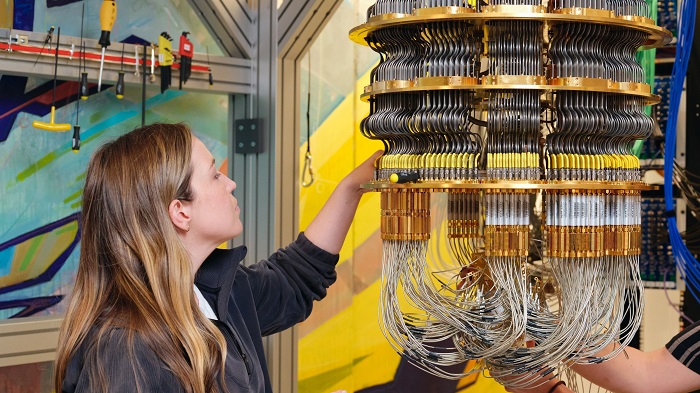
Most current quantum systems require ultra-cold dilution refrigerators operating close to absolute zero—colder than deep space—just to keep qubits stable. Achieving fault-tolerant quantum computing, where error-correction protocols protect calculations from environmental noise, remains one of the greatest engineering hurdles of our time.
So, when will the disruption happen? Industry experts generally segment the timeline into distinct phases.
We are currently navigating the Noisy Intermediate-Scale Quantum era, characterized by processors featuring dozens or a few hundred noisy qubits. During this phase, companies are experimenting with hybrid classical-quantum algorithms to solve niche optimization and simulation problems.
True, widespread commercial disruption across traditional industries is widely projected to accelerate into the 2030s. As hardware manufacturers scale up qubit counts, improve error correction, and make quantum power accessible via cloud platforms, the technology will shift from academic exploration to standard enterprise infrastructure.
Preparing Your Organization for the Quantum Shift
Disruption rarely announces itself with a sudden explosion; it creeps in through early adopters who gain insurmountable efficiency advantages while legacy players hesitate. Business leaders do not need to build quantum laboratories in their basements, but ignoring the horizon is a dangerous gamble.
Organizations can prepare today by taking pragmatic steps. First, audit your current data infrastructure and cryptographic protocols to identify vulnerabilities that future quantum decryption could expose. Second, foster internal data literacy and encourage engineering teams to monitor quantum software development kits and cloud-based testing environments provided by tech leaders. Finally, identify whether your core business relies on complex optimization, molecular simulation, or risk modeling—the primary domains where quantum computing will first rewrite the rules of competition.
The transition to the quantum age is no longer a matter of if, but when. Those who prepare for the shift will harness unprecedented computational power to redefine their industries, while those who wait risk being left behind in a binary world.
